
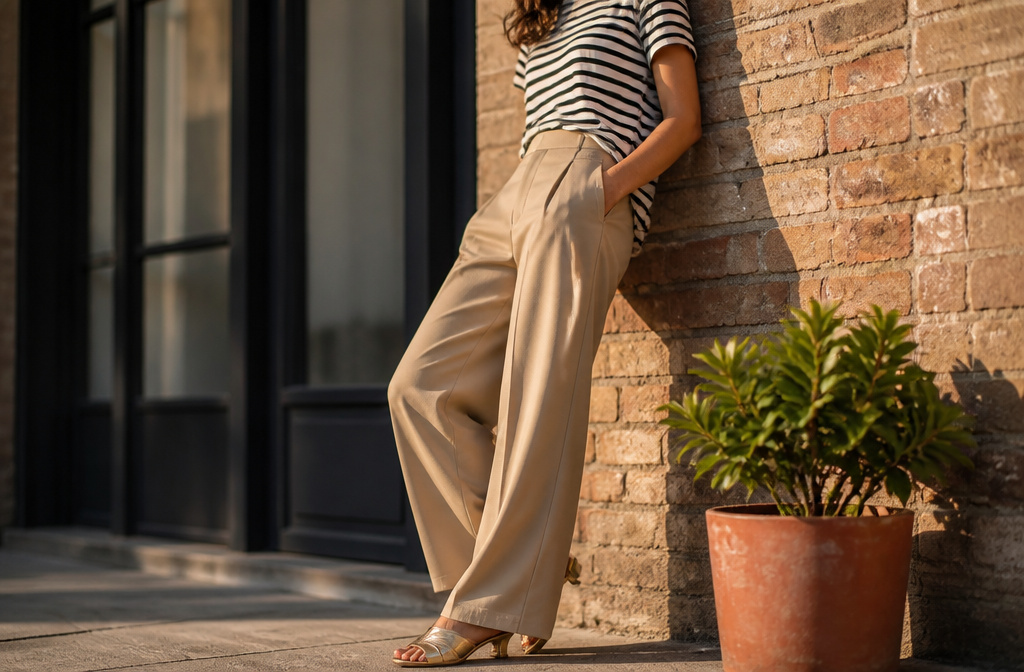
A striped tee works with almost anything, but only if the stripe width, tuck depth, and shoe profile are chosen for the specific pairing.
The half-tuck into wide-leg trousers needs a mid-rise waistband to anchor; a low rise leaves the front floating with nowhere to land. Gabriela Hearst’s $718 linen shirt shows how fabric weight alone can shift the same pairing from sloppy to boardroom-ready.
1. Wide-Leg Trousers and Ballet Flats
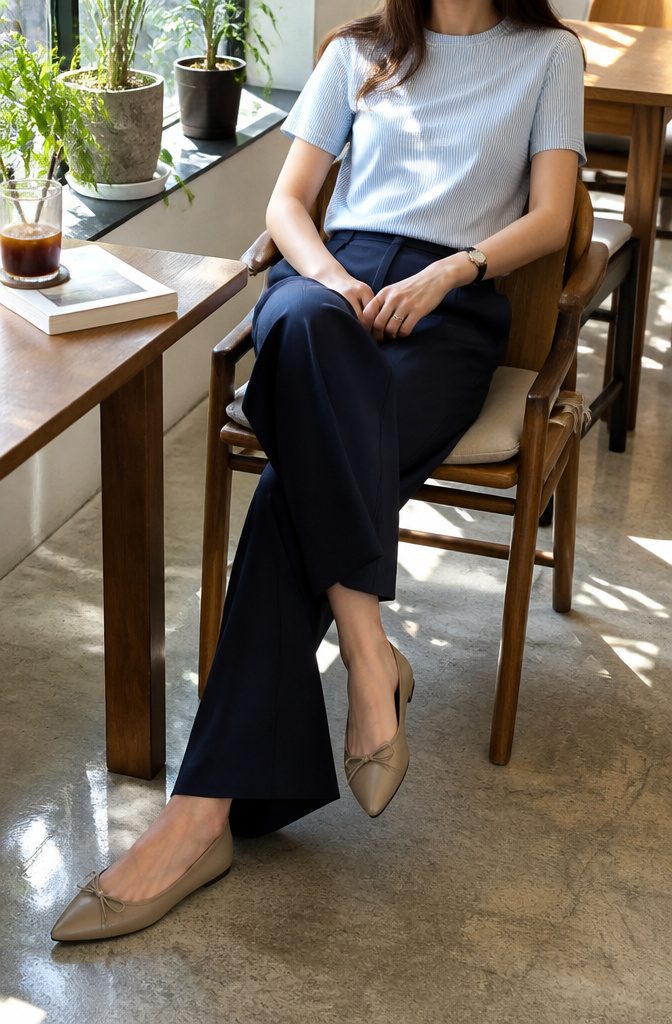
Wide-leg trousers and a striped t-shirt can read as polished as a blouse-and-slacks pairing if the proportions are handled deliberately. The half-tuck is what makes this work, but it needs a mid-rise or high-rise trouser to anchor the waistline.
A low rise leaves the tucked front floating with nowhere to land, which breaks the vertical line that wide legs are supposed to give you.
Narrow stripes, around a quarter-inch or finer, keep the top from competing with the volume below.
A bold, wide stripe on the tee turns the outfit into two large shapes stacked on each other; the finer stripe reads more like a texture and lets the trousers lead.
Linda Tol’s pairing of a light blue narrow-striped top with navy billowy trousers works because both stripes stay in the same color family and neither piece shouts.
Ballet flats finish it without adding another visual block.
A pointed toe extends the leg line where the wide leg cuts off, and the flat sole keeps the whole look from feeling like you’re trying to dress it up too hard.
The knot-at-the-waist trick from oversized tees works here too if the half-tuck won’t stay put, though a true half-tuck into a mid-rise waistband usually holds fine through a day at a desk.
2. Straight-Leg Jeans and Sandals
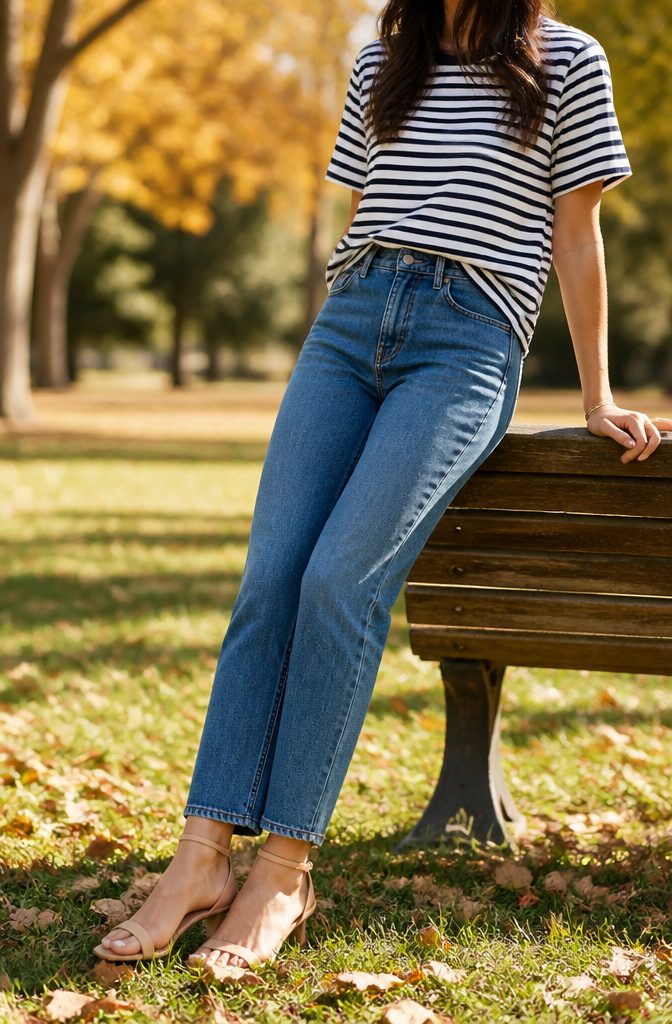
A medium wash with no heavy whiskering keeps the stripes from competing with the denim. Straight-leg jeans already carry enough structure; the tee’s horizontal lines do the visual work, so the denim should sit back.
Sandal width matters more than you’d expect. A single thin strap at the ankle and a clean footbed let the stripes stay the focus.
Multi-strap gladiators or chunky platforms fight the same eye space the stripes already claimed. I learned that the hard way with a pair of braided leather sandals that looked busy against even a narrow navy-and-white tee.
The hem hits where the tee meets the jeans.
A full tuck can feel too deliberate for this pairing; a half-tuck or leaving it loose over the waistband keeps the casual register right. Sandals in leather or a muted suede finish the outfit without shouting.
3. Skinny Jeans, Trench Coat, Pointy-Toed Heels
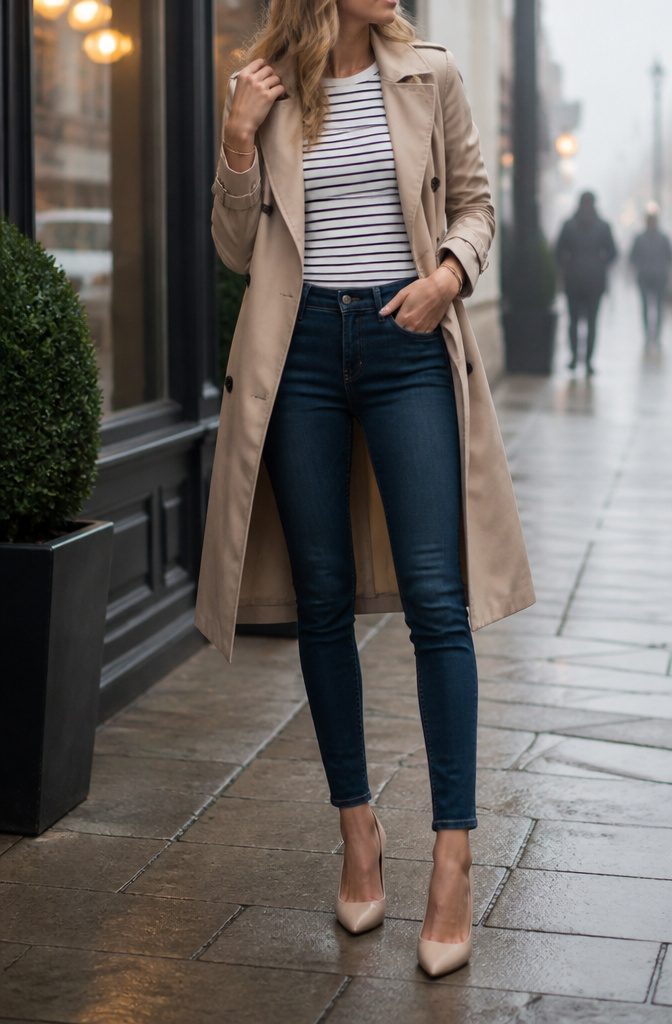
A trench coat over a striped t-shirt and skinny jeans only works if the proportions cooperate. The coat hem needs to hit two to three inches below the jean hem, not right at it.
When the two edges stack on top of each other, the eye stops there and cuts the leg line in half. That gap creates the continuous vertical sweep that makes this combination read as intentional rather than thrown-on.
Pointy-toed heels change what the stripes do visually in a way round or block heels do not. The sharp toe extends the foot line forward, so the stripes appear to travel farther.
The same heel height with a rounded toe shortens that effect by a noticeable margin. I have worn this combination with both shapes, and the pointy version makes the stripes feel like they are pulling the whole outfit upward.
The block heel breaks the line at the ankle and the stripes read as a separate top half and bottom half.
For the coat length, mid-thigh to just above the knee tends to work best with skinny jeans. Anything longer starts to compete with the narrow leg and the whole thing goes costumey.
The heel height matters less than the toe shape here, though anything under two inches tends to flatten the look into something more casual than the trench implies.
4. Jeans and Sneakers
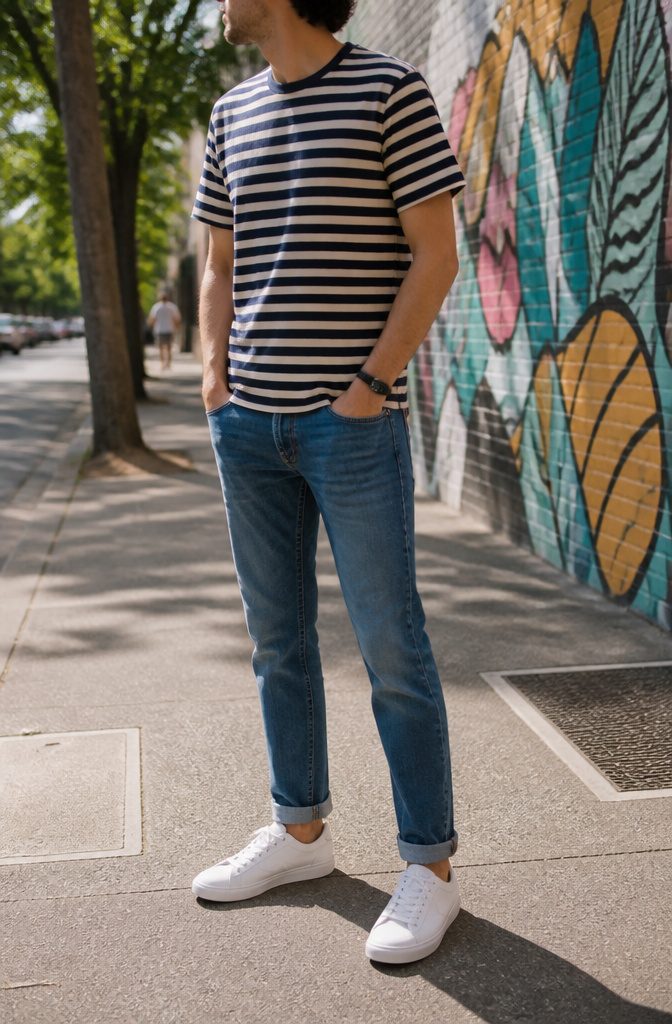
A striped t-shirt with jeans and sneakers is the outfit most of us reach for without thinking, which is exactly why the small choices matter.
The sneaker style sets the whole tone. Low-profile canvas styles keep the look clean; chunkier soles can work but need enough jean length to balance the weight.
When the stripe color matches the shoe sole, the eye travels straight down and the whole thing reads intentional rather than accidental. That trick costs nothing and takes a second to check in the mirror.
The jean break should sit right at the top of the sneaker, not pooling on the laces and not hovering above like you’re waiting for a flood.
A half-inch of fabric resting on the shoe is the spot where the leg line stays longest and the shoe still gets seen.
Cuffing works if the denim is stiff enough to hold the fold; soft denim cuffs collapse and add bulk at the ankle you didn’t plan for.
5. White Jeans
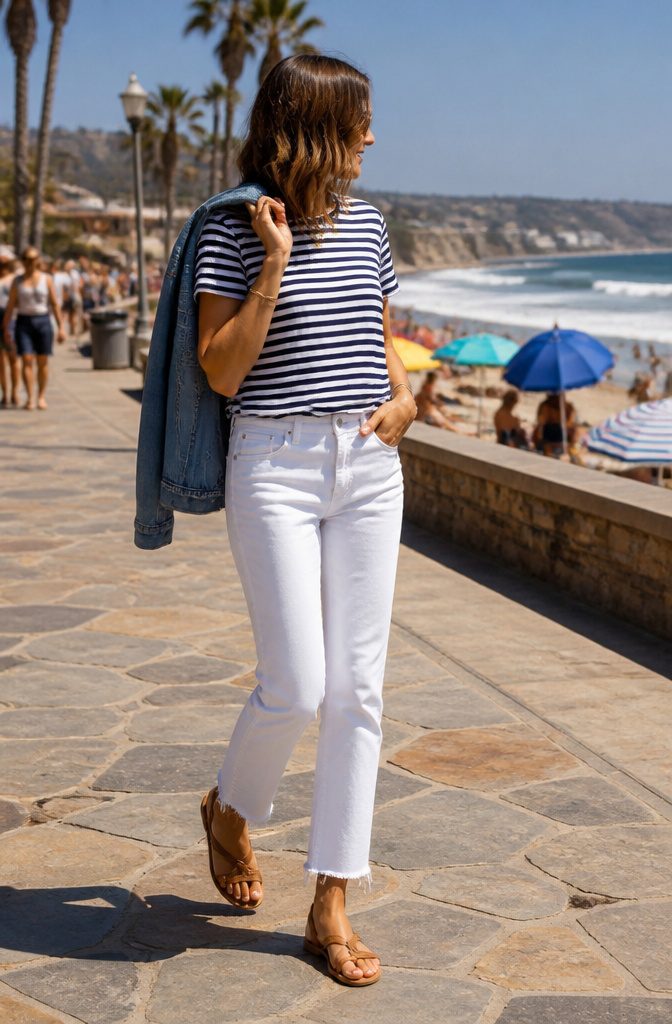
White jeans turn a striped tee into something that reads seasonal rather than habitual.
Stripe opacity against the denim wash matters more than you’d think: a dense navy or black stripe holds its own against bright white, while a faded or narrow stripe can disappear into the glare and look accidental.
Fabric weight matters here too. A thin jersey that turns sheer in sunlight will show every line of a pocket lining through white denim, so a mid-weight cotton or a lined tee saves the look.
Shoe choice is where this combination lives or dies. Leopard flats add texture without shouting.
Nude heels keep the leg line long and the outfit anchored in real life rather than costume territory. Boots work only when the temperature actually calls for them; otherwise the pairing starts to read like a French-film stereotype.
A half-tuck or a knot at the waist keeps an oversized tee from going sloppy against the crispness of the jeans.
A denim jacket layered on top works for evening chill, but skip the matching wash: contrast in the blues keeps it from looking like a uniform.
6. Leggings and a Cardigan
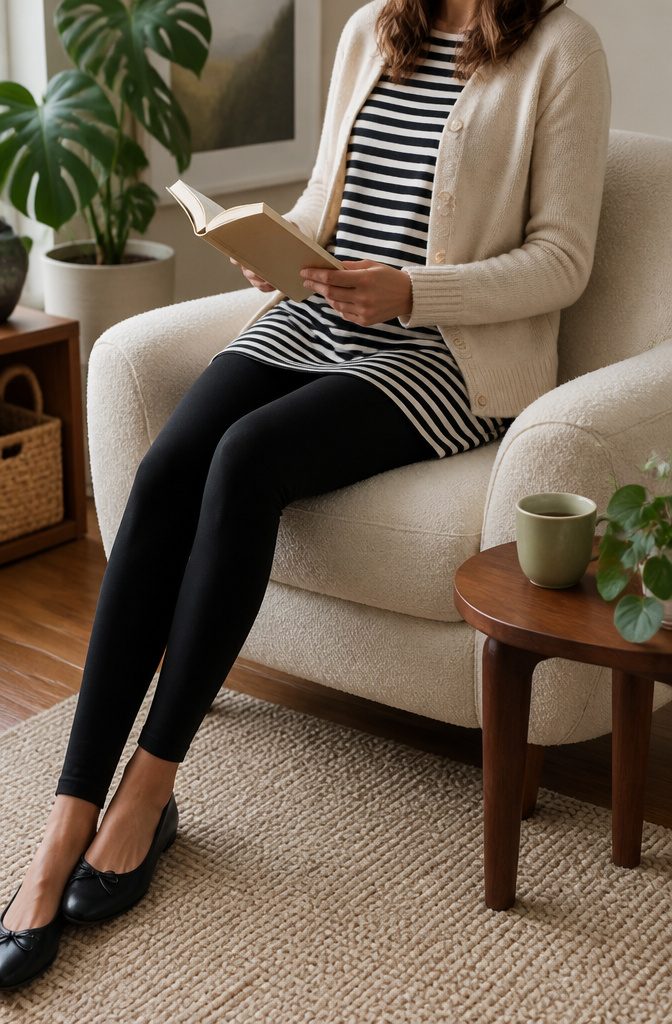
A tunic-length striped tee makes the difference between an outfit and an afterthought. Regular-length tees ride up over leggings within an hour, leaving you tugging at your hem in parking lots.
The extra four to six inches of coverage keeps the silhouette clean from hip to thigh, which matters when leggings read as tights the moment fabric bunches wrong.
Cardigan length is where most of us miss.
Hip-length cardigans cut the body in half and emphasize whatever sits at that line; a mid-thigh duster or a cropped style that hits at the natural waist both work better than the safe middle ground.
I reach for a cropped cashmere blend when I want structure, a lightweight duster when I want the elongation.
The intentional part comes down to two details: shoe choice and whether the tee is tucked.
Leaving it loose works only with the tunic cut. With a regular tee, a front tuck into the leggings’ waistband, just two inches deep, creates a waist and stops the "forgot to change out of loungewear" effect.
Leather loafers or clean white sneakers finish it; fuzzy slippers or running shoes tip the look the other way.
7. Denim Shorts
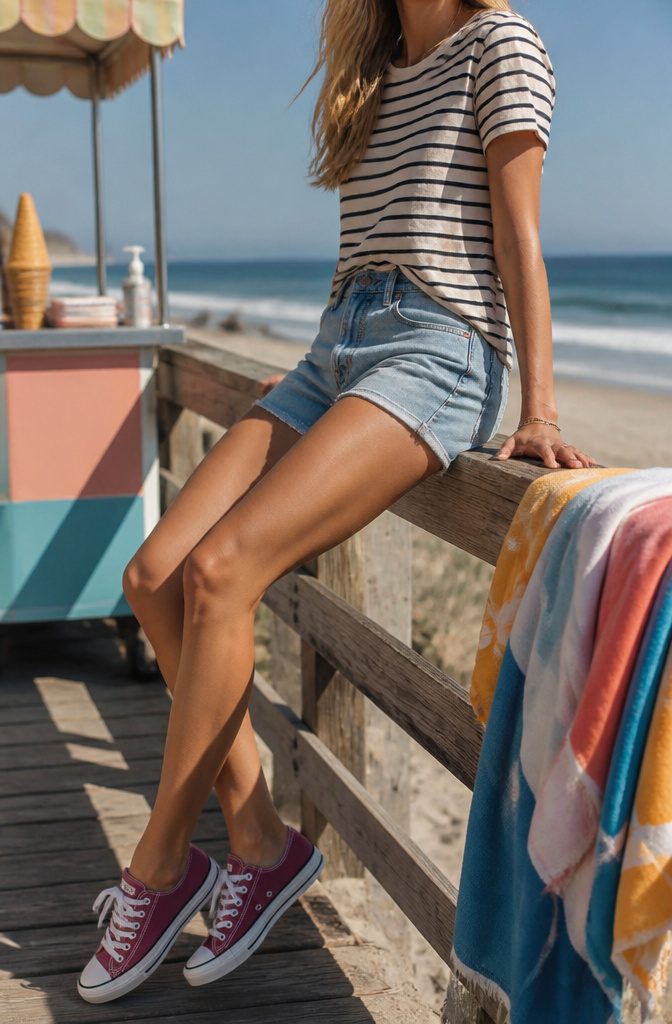
A three-inch inseam tends to hit at the widest point of most thighs, which can cut the leg short visually.
Five inches usually works better for anyone who wants the line to keep going, and longer lengths hold their structure through actual activity rather than riding up the first time you sit.
The source material does not specify exact inseams, but the general range in ready-to-wear runs 3–5 inches for standard cuts and 7–9 inches for Bermuda styles that read more polished.
Tucking a striped tee into denim shorts sounds simple until the waistband bulk shows through the stripes.
A half-tuck, just the front hem eased in with the back left loose, keeps the pattern flat across the torso and avoids the diaper effect a full tuck can create in stiff denim.
The front point of the tuck should sit at or just below the top button, not centered like a cocktail napkin.
Shoes make or break this combination, and the default flip-flop is where most women stop trying.
Converse sneakers give the outfit a deliberate edge without adding heat. Colorful sandals work if the straps have some structure, but the thin rubber thong reads beach-only and undercuts whatever the shorts and tee accomplished.
You want to look like you chose this, not like you grabbed what was closest to the door.
8. Tucked Into a Midi Skirt
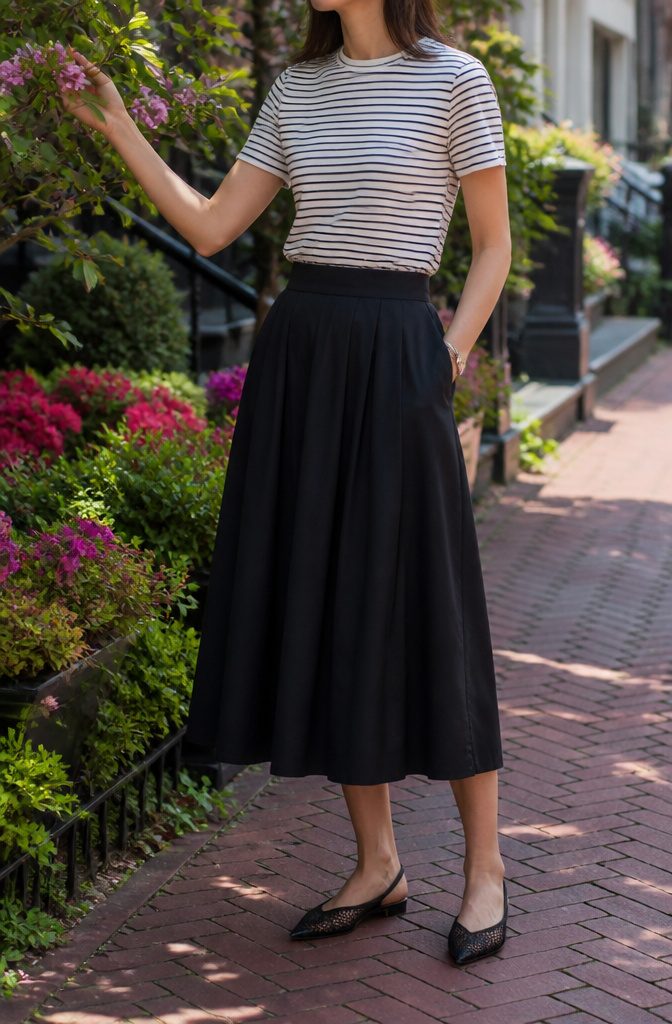
A fitted striped tee, not an oversized one, is the better choice for tucking into a midi skirt. The fabric of the tee matters more than most people expect.
A knit cotton tee will bunch and ride up at the waistband, so the half-tuck or a French tuck with a single point usually holds for about an hour before it rebels.
A woven tee with some structure stays where you put it and keeps the line of the skirt clean.
Stripe width needs to talk to the skirt’s fullness. Narrow stripes against a pleated midi fight each other visually; the eye reads too many lines at once.
A wider stripe, or a stripe spacing that opens up, gives the pleats room to do their work. With a slimmer A-line or straight midi, narrower stripes work fine because the skirt itself isn’t adding competing geometry.
Waistband placement is the other half. A midi skirt that hits at the natural waist pairs cleanly with a tucked tee.
If the waistband sits lower, at the hip, the tucked tee has to travel farther and the bulk shows. In that case, leaving the tee untucked or cropping it is the more honest move.
9. Layered Under a Sweater
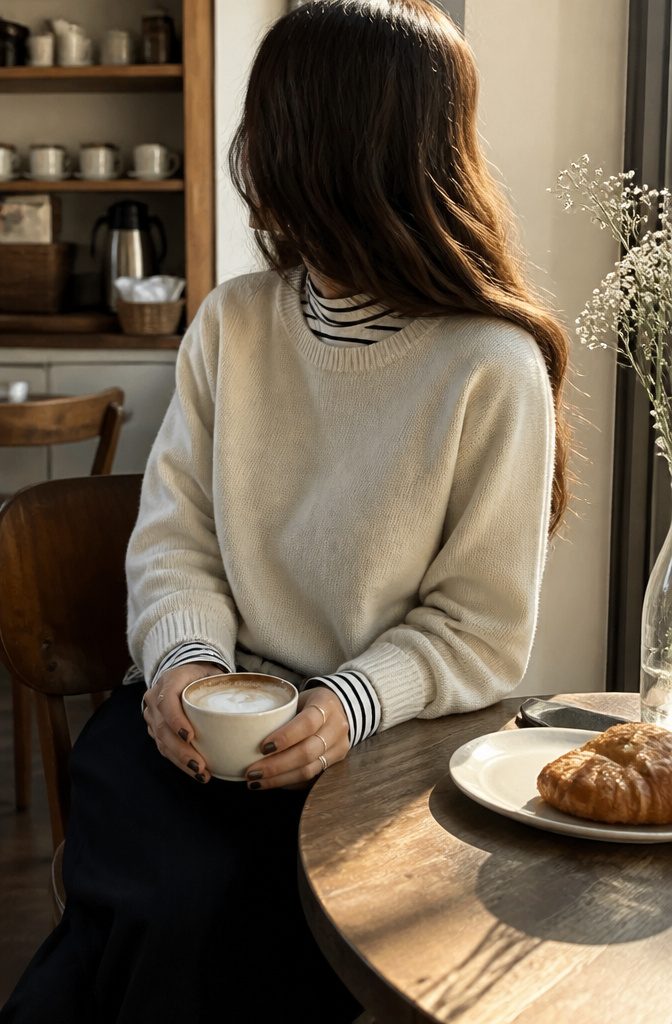
A striped tee under a sweater only works when the neckline cooperates. V-necks and crews leave enough frame for the collar to read; turtlenecks bury it entirely.
A short-sleeve or crew-neck tee works as the base layer, or you can reach for a fitted long-sleeve with extra length at the wrists so the stripes show at both ends.
Both approaches work, but the long-sleeve option gives you arm visibility without the bulk of a short sleeve bunching under a fitted sweater.
Color choice matters more than you’d expect.
A thick knit diffuses whatever sits beneath it, so navy and white stripes read as a soft gray blur under oatmeal or cream knits; black and white flatten to a tone that competes with the sweater rather than supporting it.
The stripe width shrinks in translation too. Wide bands under cable knits turn to indistinct shadow; narrow stripes hold their identity.
The hem is the last decision.
A full tuck defeats the purpose. Leaving two to three inches below the sweater waistband gives the layering its point, but much more and the proportions start to read accidental rather than intentional.
Jeans and ankle boots finish it cleanly; anything fussier fights the simplicity of the move.
10. Joggers

Joggers only read as an outfit when the fabric has enough weight to hold a crease and the taper stops above the ankle, not at it.
A mid-weight cotton or cotton-poly blend with a slim, cuffed leg gives the striped tee something structured to sit against.
The tee should hit at mid-hip, untucked, so the horizontal lines stay level across the torso rather than bunching at the waistband.
The shoe swap that matters: running shoes or fuzzy slippers keep this in lounge territory, but a leather sneaker, loafer, or low-profile boot immediately signals intent.
The sole should be slim, not platform-thick, and the upper clean enough that it could handle a casual office if needed.
I learned this the hard way after wearing a pair of chunky trainers to brunch and spending the whole meal feeling underdressed; swapping to a white leather sneaker the next week changed nothing else about the outfit but fixed the entire impression.
Color works best in opposition: a navy-and-white stripe with olive or charcoal joggers, or a black-and-white stripe with camel or stone.
Matching the stripe to the pant too closely drifts back toward pajama set territory. A single accessory, a watch or small hoop earring, finishes the line without overworking it.
11. Under a Sleeveless Top or Dress
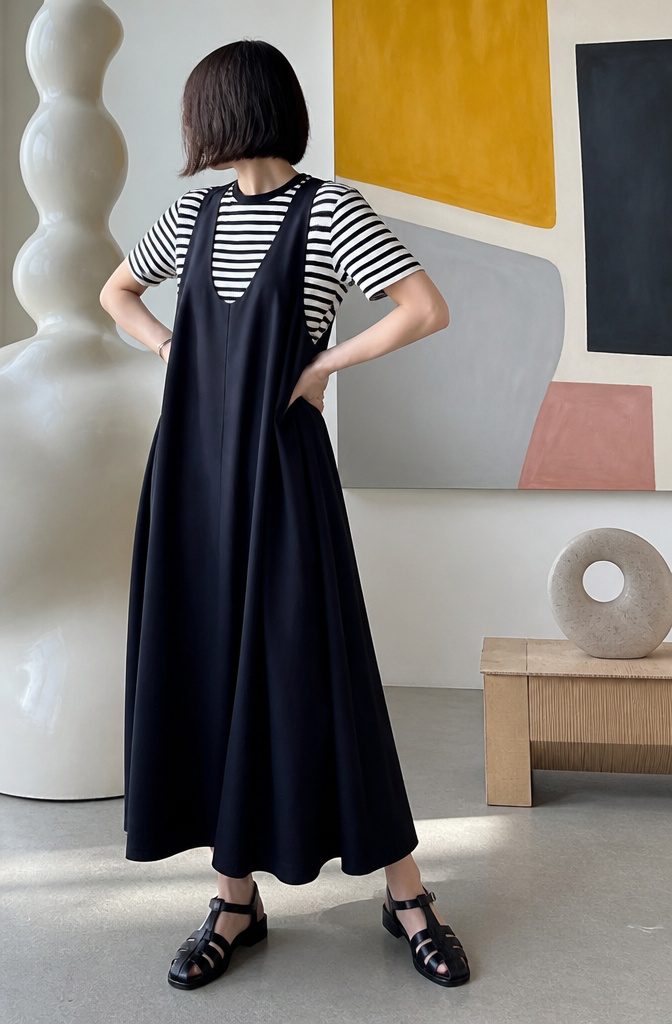
A striped t shirt outfit under a sleeveless layer lives or dies on armhole depth. Too wide and the tee bunches at the shoulder like an afterthought; too narrow and you lose the stripe peeking through entirely.
I look for armholes that sit at least two inches below the shoulder seam, which leaves enough frame for a short sleeve striped shirt to read intentionally rather than like an undershirt.
The stripe visibility question is trickier than it sounds. Thin fabrics, especially the kind of slip dresses that keep surfacing lately, can turn a crisp stripe into a muddy blur.
A denser stripe spacing holds up better under something semi-sheer than a widely spaced one, which fragments and loses its geometry.
If the dress fabric has any texture to it, like a crepe or a light rib, the stripe underneath needs enough contrast in its own colorway to survive the filter.
Necklines matter almost as much as the armhole.
A strappy dress with a low scoop leaves the tee collar floating in space, so I prefer a crewneck or a shallow boatneck on the striped shirt that can meet the dress line cleanly.
Turtlenecks under sleeveless dresses are the winter version, and they work because the neck itself becomes the frame; no loose ends to reconcile.
Summer shifts the same logic to a tank dress and a short sleeve striped tee, but the neckline still needs that deliberate meeting point.
Sweater vests and sleeveless cardigans follow the same rules, though the thicker fabric forgives more.
What kills the look is always the same: a gap between where the tee ends and the vest begins, or a stripe so pale it disappears under the layer.
12. With a Leather Skirt
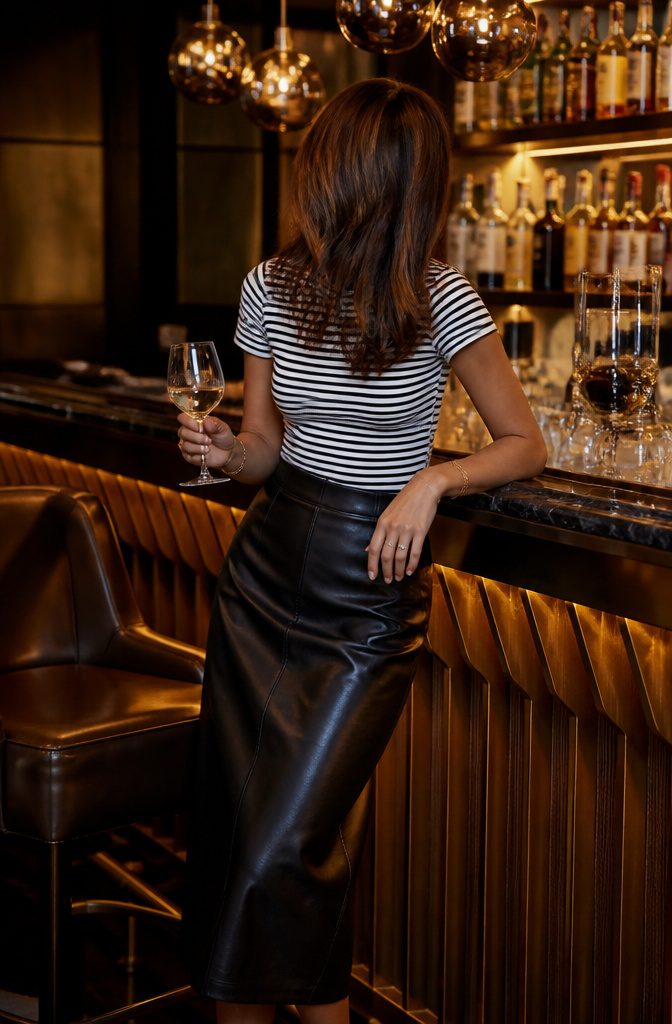
A midi-length leather skirt gives the striped tee its best shot at looking intentional rather than thrown on.
Merrick’s Art insists on a fitted tee tucked in, warning that oversized shapes fight the waistband, while Marie Claire treats the pairing as a polished city look without specifying tuck status.
Two ways to play this. A fitted stripe with a half-tuck or full tuck keeps the line clean and lets the leather shine.
A looser tee left untucked works only if the hem hits at or just below the waistband, so you still read shape somewhere.
Stripe width matters less than fit here, though narrow stripes tend to feel sharper against leather’s gloss than wide ones.
I reach for short sleeves in warm weather, long sleeves when the skirt is black and the day calls for more coverage. Either way, the contrast lives in the textures, not the colors, so a neutral stripe almost always wins.
13. Matchy-Matchy Striped Set
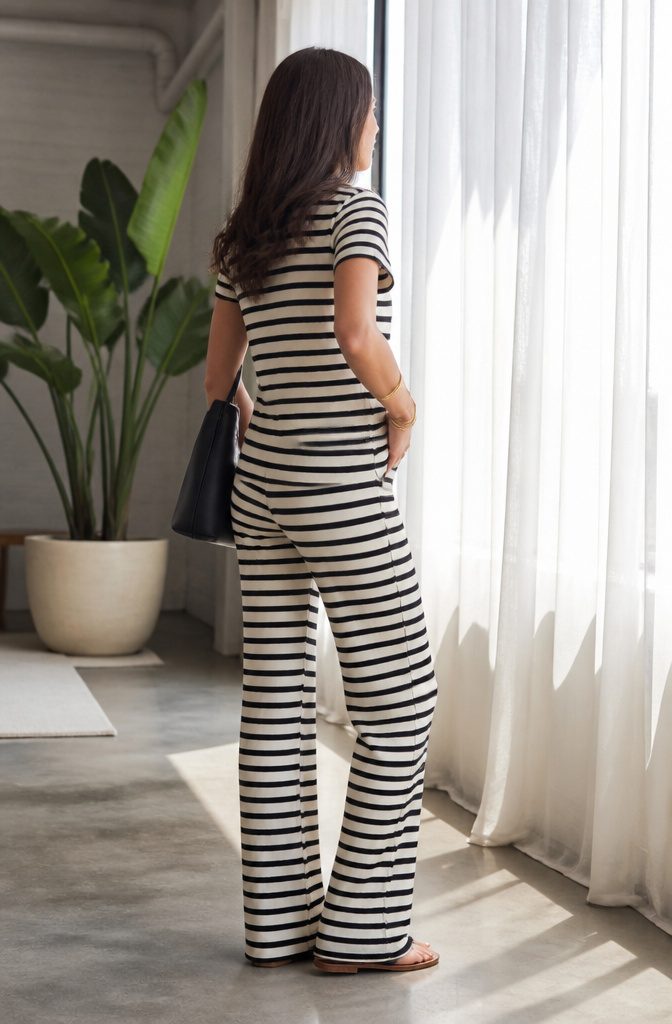
A full striped t shirt outfit built from matching top and bottom only works when the stripes share the same spacing.
Two millimeters apart on the shirt and twelve on the pants turns the set into a visual argument; the eye catches the mismatch before it registers the coordination. Same width, same gap, and the body reads as one continuous line.
I learned the spacing rule after trying a breton tee with sailor pants that looked related in the store and like a mistake in daylight.
The fix was simpler than the regret: lay the pieces flat together before buying, or hold them up in natural light if you’re shopping in person.
If the repeat doesn’t match, treat one piece as the anchor and add a solid third piece to break the set.
A cropped denim jacket, a long open cardigan, or even a tucked-in solid tank with the striped pants pulled up to read as trousers all stop the stripes from fighting.
The solid layer should hit at the waist or the hip, never mid-stripe, so the interruption looks intentional rather than like coverage.
A belt in a third color can seal the break and give the eye a place to rest. Without that rest, matching stripes exhaust whoever’s looking, including you in the mirror by noon.
14. Unique Details and Hardware
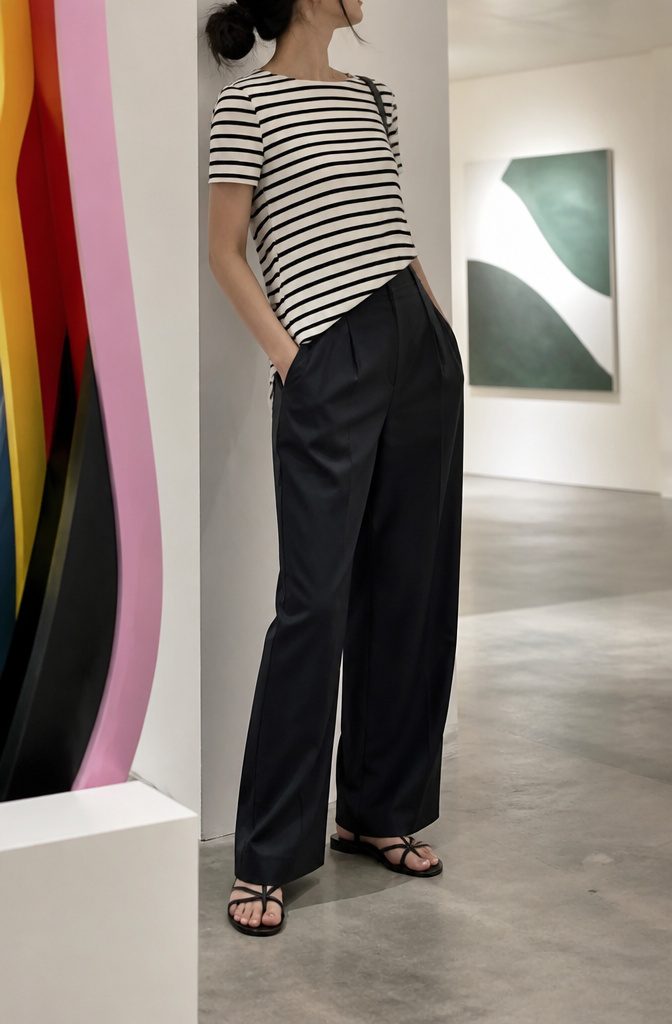
A striped tee with an asymmetric hem or contrast trim does half the styling work for you. The detail already carries the outfit, so the rest has to stay quiet.
I learned this the hard way after buying a Breton-style shirt with a navy band at the collar and cuffs, then pairing it with cropped kick-flare jeans that had their own contrast stitching.
Two competing focal points, and neither won. Now I keep the bottom half single-finish: raw-hem straight jeans, a plain linen midi, or solid cotton trousers with no topstitching to speak of.
Buttons running down the back or a single exposed shoulder also shift where the eye travels. Bottoms that sit clean at the waist, no belt loops screaming for attention, let that line finish uninterrupted.
A high-waisted A-line skirt in one color, or slim trousers with a side zip instead of a front fly, keeps the silhouette smooth.
Stripes are the perfect base for showing off the more outrageous pieces in your closet.
The same logic works in reverse. A striped tee with its own built-in twist, like that cold-shoulder cut Marie Claire flagged, already is the outrageous piece.
Treat it that way. One statement per outfit, and let the detail lead.
15. Trench Coat and White Trousers
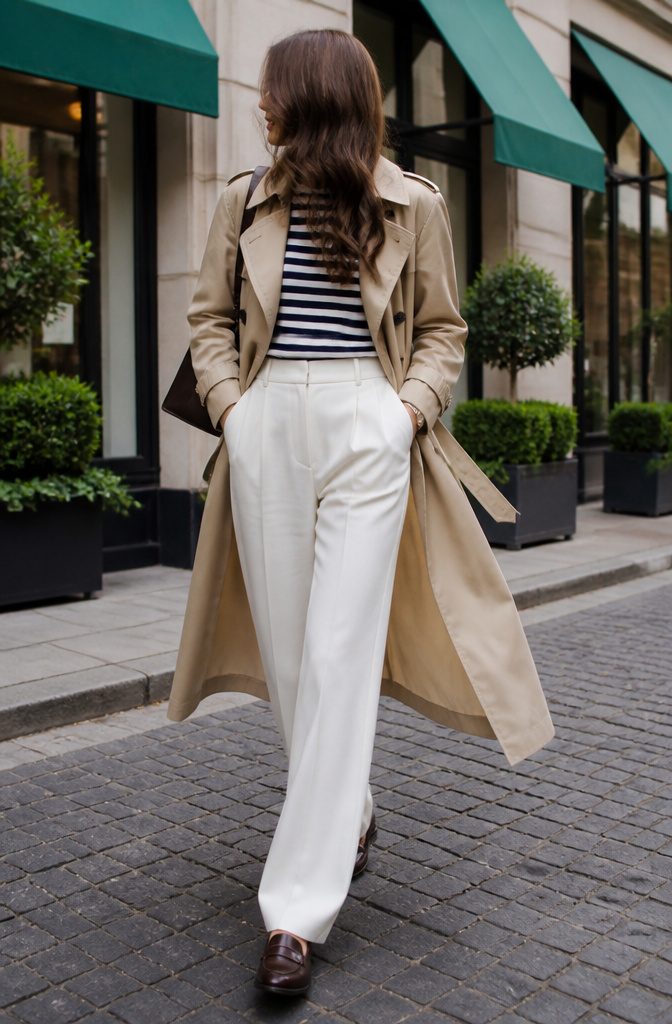
A navy and white striped tee against white trousers creates the clean contrast that makes this pairing work. The stripe reads crisp rather than busy, which matters when the trench coat is doing half the visual work.
I’ve found that thinner stripes hold up better here than thick rugby bands, which can start to look like a costume once the belt cinches.
Trench belt positioning changes the whole silhouette. Worn loose and buckled at the back, the coat falls straight and keeps the look relaxed for daytime errands.
Tied at the natural waist, it pulls the outfit together for a dinner where you need to look considered without being formal.
Shoe choice splits this into two entirely different occasions. White leather sneakers keep the palette unified and handle a full day of walking; the outfit stays casual but intentional.
Switch to a pointed black flat or a low slingback, and the same three pieces translate to a client meeting or an evening reservation without changing anything else.
The trench does the heavy lifting either way, so the shoe signals intent rather than adding new information.
16. Striped Button-Down as Alternate
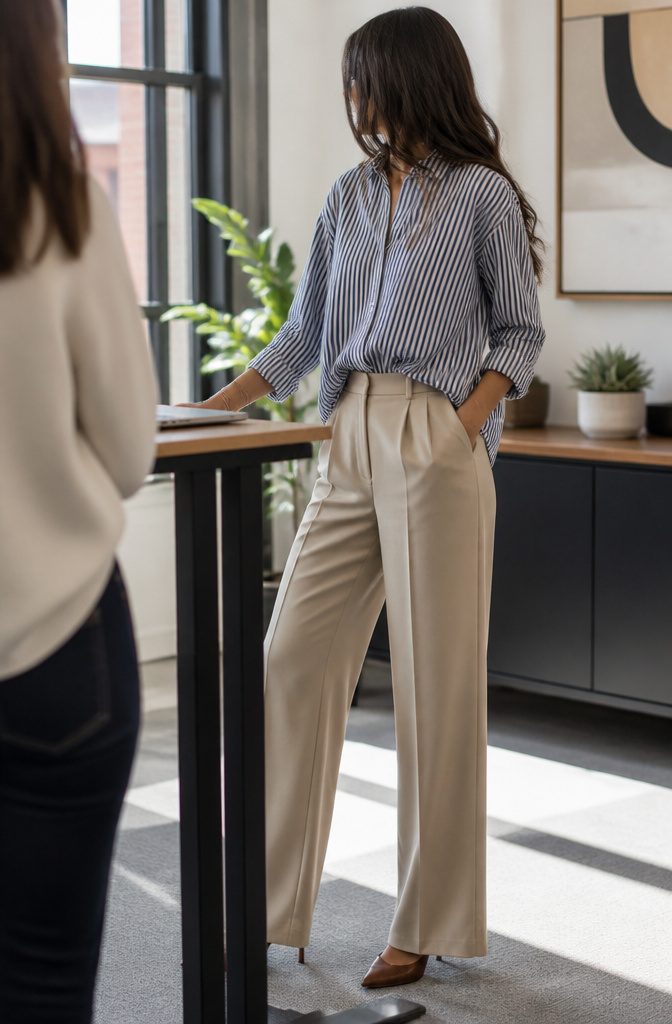
A striped button-down swaps in for the tee when the occasion needs more structure, but the same pairings still work if you respect the fabric.
Half-tuck the shirt and let the tail hang behind; the buttons give you control a pullover never could, and the collar frames your face whether you pop it or let it lie flat.
The Gabriela Hearst linen shirt at $718 shows the weight difference: a button-down in that kind of cloth holds its own against a long coat and nude heels for work, while a thin striped tee would crumple and read sloppy under the same pieces.
Heavier cotton or linen button-downs need the waist definition a tuck provides; jersey tees skim and forgive, but a stiff shirt left untucked can box out your shape entirely.
Collar treatment matters too. Spread collars sit better open over a crewneck layer, button-down collars keep neat if you add a sweater on top.
The mistake is treating the two garments as interchangeable fabric-wise: the same white jeans that look crisp with a structured shirt can feel mismatched when the shirt is too flimsy to hold the half-tuck.
17. Color Block Against Stripes

A color block piece should pull from one stripe tone, not compete with both.
The olive bottoms from that Summer 2023 capsule wardrobe formula work because they isolate a single color the stripes already carry, letting the pattern stay the focal point without the outfit turning into a contest.
White trousers do the same job for a sharper occasion. The stripe pattern stays busy enough on its own, so the solid block needs to be exactly that: solid, uninterrupted, and at least 60% of the look by area.
Two competing patterns, or two stripe scales, and the eye has nowhere to rest.
The ratio matters more than the specific colors.
Striped tops already bring two, sometimes three tones. Adding a third through your bottom half is where it goes wrong.
Pick the stripe color you want to emphasize, match your block piece to it, and keep your third piece, whether sneakers or heels, in a neutral that reads as ground rather than statement.
18. Prints and Patterns Mixed With Stripes
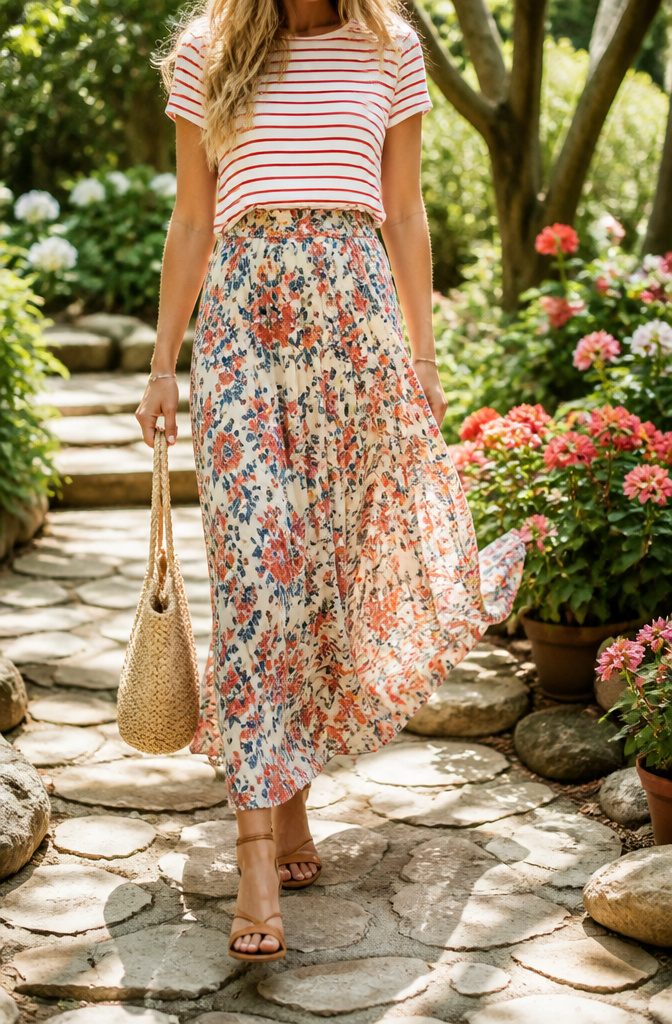
Stripes with plaid only works when the plaid picks up tones already in the stripe. A pastel plaid against a navy-and-white Breton reads intentional; a clashing red tartan against the same shirt reads like you got dressed in the dark.
The scale rule matters more than the pattern name: one print large, one print small, or both medium but different geometries. Two busy patterns at the same scale fight for attention and the eye gives up.
Florals cooperate better than most people expect, especially garden prints with enough open ground between the blooms to let the stripes breathe. Leopard flats work too, though that edges into neutral territory since animal prints function almost as textured solids.
Three colors maximum across both pieces keeps the mix from turning into costume; beyond that, something has to go back in the closet.
I have tried stripes with micro-checks and regretted it: both patterns demand the same reading distance, so neither wins.
Stripes with a single bold floral? That pairing has lasted in my rotation because the stripe acts as the quiet base and the floral does the talking.
19. The Casual Half-Tuck
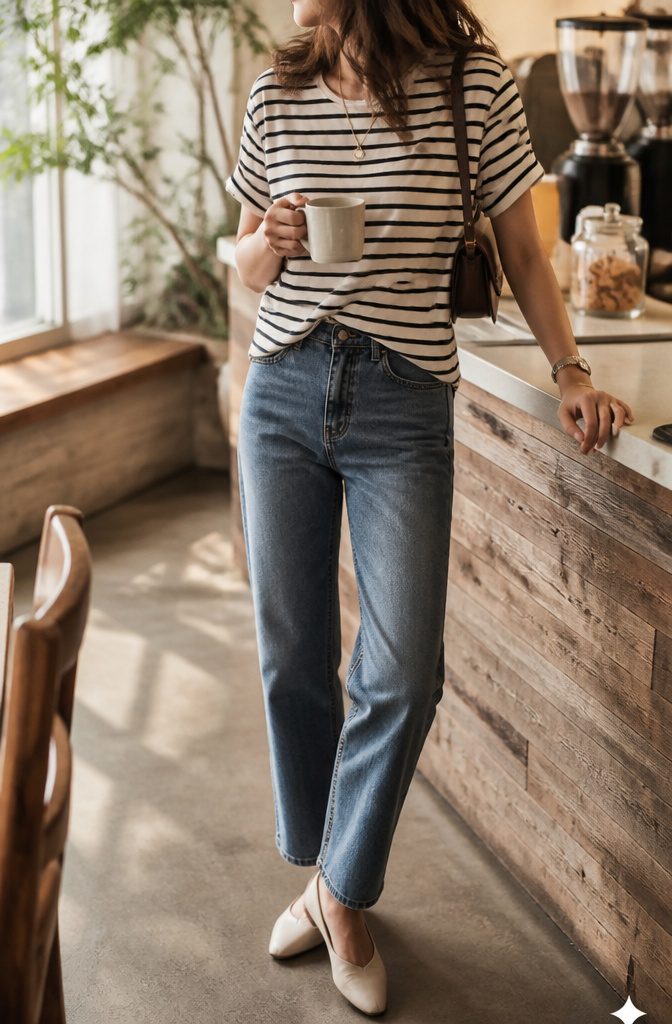
A half-tuck with a striped tee only works if the tuck point hits exactly at the waistband, not above it.
Any higher and the fabric bunches into a shelf; any lower and you lose the waist definition that makes the move worth doing.
Horizontal stripes tuck the cleanest because the fold line stays parallel to the band and reads as intentional. Vertical or diagonal stripes fight the waistline and tend to twist or gap by noon.
The untucked side needs enough length to hang straight, roughly to mid-hip, or the whole silhouette tilts off-balance.
One fist-width of fabric loose on the hanging side is usually the right amount; more than that and the tee starts reading as a mistake rather than a choice.
Let the back fall completely untucked. The contrast between the anchored front and the relaxed back is what keeps the look from trying too hard.
20. Accessories That Finish It
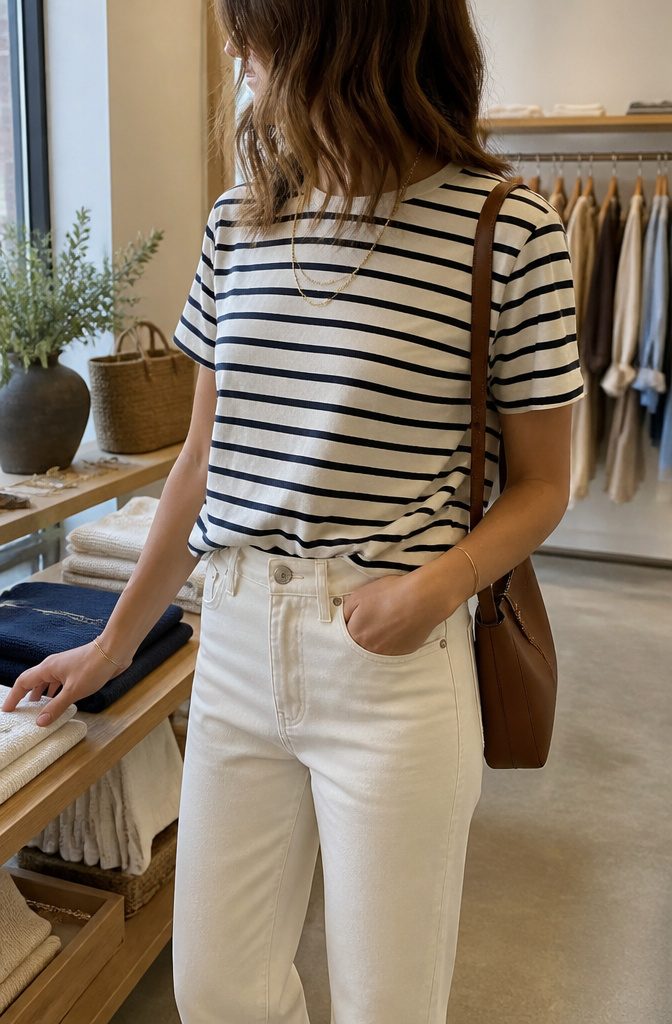
A delicate chain in the same metal tone as the stripe’s accent color reads intentional, while a chunky mixed-metal stack fights the clean geometry of the shirt.
Scale matters more than most people think: a pinstripe tee disappears under a oversized tote, so a medium-structured bag keeps the proportions honest.
Silk scarves work if the stripe is narrow enough that the scarf’s print doesn’t turn the neckline into a traffic jam; with a bold Breton width, bare neck or a single stud is the safer call.
The mistake that cheapens the whole look is matching the stripe color exactly in every accessory. A red stripe does not need red earrings, a red belt, and red shoes.
One echo is enough; two starts looking like a uniform, three looks like you tried and missed. Metal is the safer through-line: gold hardware repeated twice, or silver, gives coherence without the costume effect.
Hats follow the same rule: a straw fedora with a thin black band picks up a black stripe cleanly; a patterned bucket hat competes for attention the shirt already claimed.
21. Unique Jacket Shapes

A cocoon jacket thrown over a striped tee changes the whole silhouette without hiding the point of the outfit.
The rounded volume plays against the horizontal lines, and the hem should land just at or slightly below the tee hem so the stripes peek out like a deliberate layer rather than an undershirt slipping free.
I learned this the hard way after buying one that covered the stripes entirely; the outfit read as a plain black coat and nothing more.
Bombers work the opposite way. Their ribbed band sits at the waist, which means a longer striped tee extending an inch or two below the jacket reads as intentional, almost like a skirt layer.
Strong-shouldered blazers fall somewhere between. The structured line at the shoulder needs the stripe to show at the collarbone and at the hem, so a cropped tee or a full tuck keeps both zones visible.
Let the tee hang to the same length as the blazer and the eye loses the stripe entirely, which defeats the purpose of building around it.
22. Denim Jacket Layering

A denim jacket over a striped tee only works when the wash talks to the stripe color rather than fighting it.
Medium and dark washes read as neutral enough for navy or black-and-white stripes; light washes pair better with softer, off-white bases or thin pinstripes that won’t get visually crowded.
The real decision comes at the sleeves. Rolling them one turn shows a two-inch band of stripe at the wrist, which breaks up the jacket’s boxiness and proves you didn’t just throw it on.
Two turns looks deliberate; three turns looks like you’re about to do manual labor.
Jacket length matters more than most people account for.
A cropped denim jacket, ending right at the waistband, works with a fitted tee tucked into high-rise bottoms. Anything longer than that, and the tee needs enough room through the body that the jacket can sit open without pulling.
A hip-length trucker jacket over a boxy or oversized striped tee creates a column of vertical stripe down the center, which is why you bothered with stripes at all.
If the tee is longline, the jacket must be shorter, or the proportions flatten into a shapeless block.
23. Under a Turtleneck
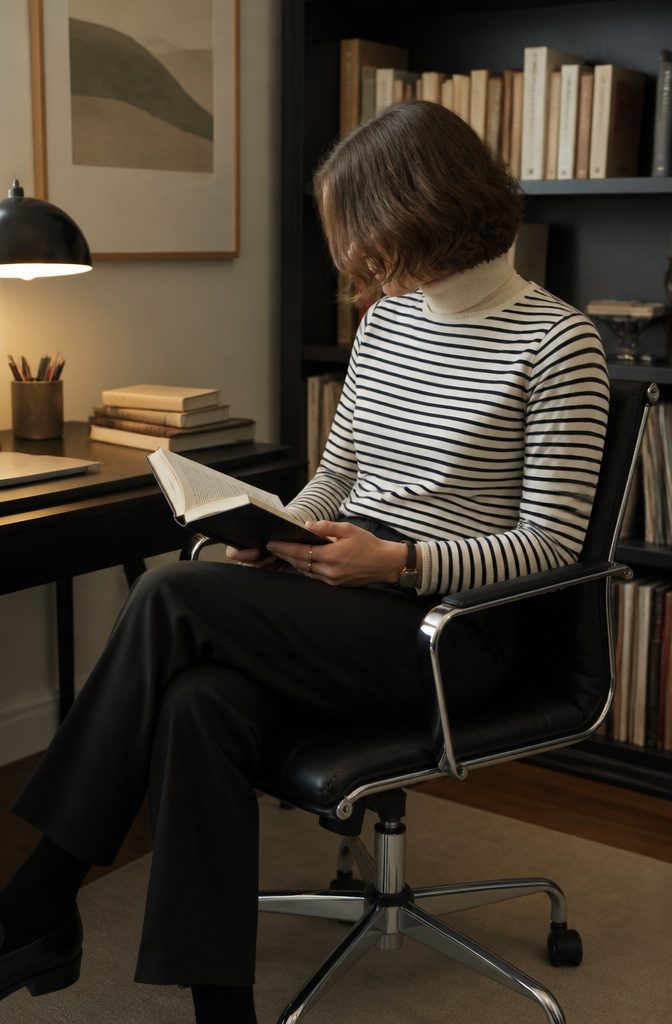
A striped tee under a turtleneck only works when the turtleneck is thin enough to let the stripes read as deliberate, not accidental. A dense knit kills the effect; the hem just looks like a shirt you failed to tuck.
Now I stick to fine-gauge merino or lightweight cashmere that skims the body without squeezing it; anything thicker turns the stripes into a rumpled afterthought.
Navy and white stripes show through pale knits better than black and white, which tend to read as shadow or dirt.
Cream turtlenecks over cream-based stripes, burgundy over navy stripes: the pairing needs enough contrast to register as layering, not enough to fight. The cuffs are the tell.
Let an inch of stripe sit at the wrist, maybe two at the hem, and the proportions look considered. More than that and you’re wearing two shirts at once; less, and the eye assumes laundry day.
24. With a Crewneck or V-Neck Sweater

A crewneck sweater over a striped tee only works if the neckline is wide enough to show a real collar, not just a sliver of fabric.
Aim for a neck opening that sits two fingers below your clavicle; anything tighter swallows the stripe entirely and reads like an afterthought.
V-necks are more forgiving because the point draws the eye down and frames whatever stripe pattern sits at the chest.
Navy and cream stripes disappear under camel, oatmeal, or olive sweaters; the tones are too close to fight for attention.
Black and white stripes against charcoal or heather gray do the opposite, they buzz visually and look accidental unless the sweater is intentionally oversized and the tee is deliberately long in the hem and sleeves.
I learned that the hard way with a thin gray cashmere crew that turned a Breton shirt into a blurry mess at a morning meeting.
Red-based stripes need restraint: a navy sweater calms them, but burgundy or rust creates a color clash that flatters almost no one. The stripe width matters less than the contrast level.
Fine stripes read as texture from a distance and pair with more sweater shades; thick stripes need a solid sweater color with at least one tone in common, or they look like a flag you did not mean to fly.
25. Beach Coverup Alternative
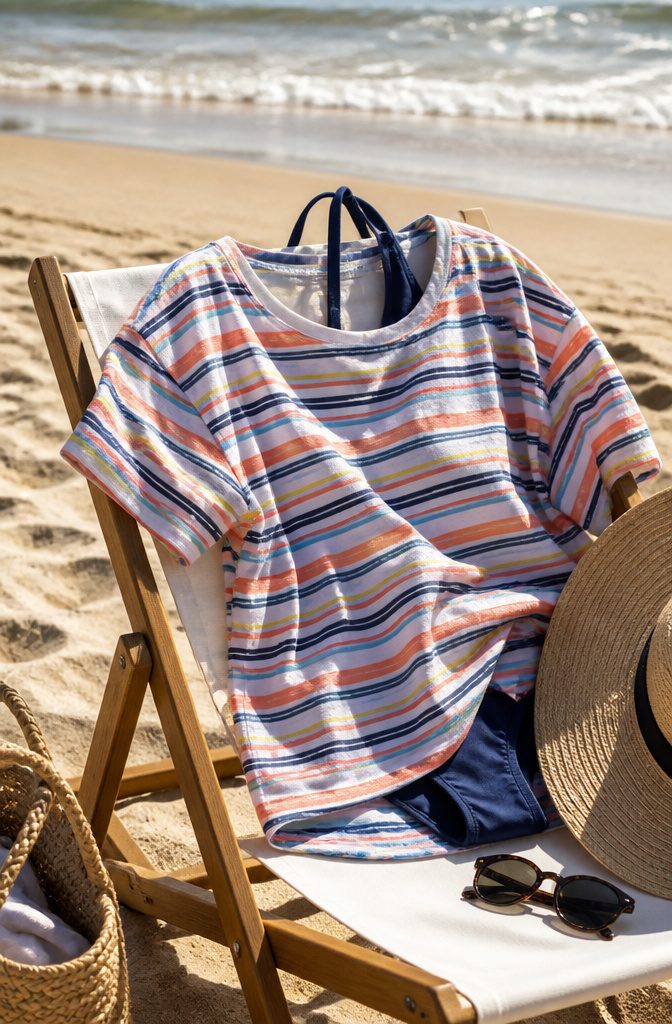
A striped t-shirt outfit works at the beach only if the fabric does not turn transparent the second it gets wet.
Medium-weight cotton or a cotton-linen mix holds its shape and coverage where tissue-thin jersey clings and betrays every line of the suit underneath. The hem should hit mid-thigh at minimum; anything shorter rides up with movement and leaves you tugging.
Sandal choice determines whether you can walk straight from sand to a lunch table without changing.
A flat leather slide in a tan or cognac tone reads intentional where rubber flip-flops read pool-only. The upgrade takes thirty seconds and saves a trip back to the car.
I learned the fabric lesson the hard way with a striped tee that looked substantial dry and turned into a second skin at the first splash.
Now I hold striped coverup candidates up to a window before buying. If the light comes through clearly, the fabric is too light for the job.
26. Colorful Shoes as Statement
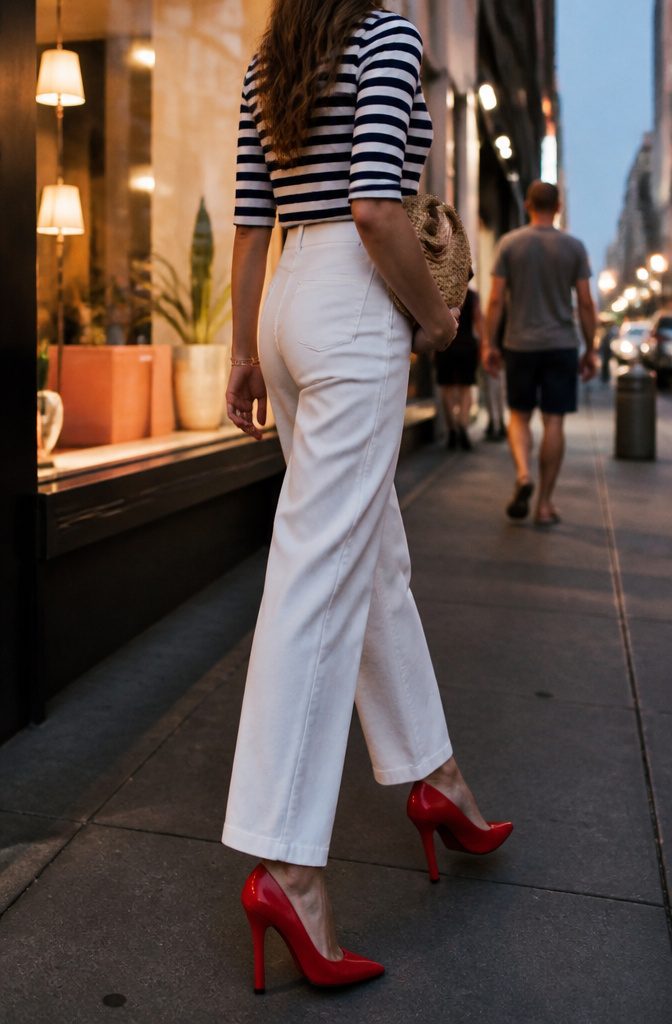
A navy-and-white striped tee with white bottoms already reads crisp and finished, so the shoe is where the outfit either loosens up or tries too hard.
Red pumps or cobalt loafers feel playful here because the stripe itself is restrained; the shoe gets to be the one risky move.
Yellow or orange stripes, on the other hand, already carry that much energy, so a competing bright shoe starts to look like costume rather than choice.
With those warmer stripes, a cleaner neutral or a single darker accent keeps the whole thing wearable past one season.
The best versions treat the colorful shoe as a single pop, not a theme. One summer formula pairs the classic striped tee and white bottoms with one saturated shoe and nothing else competing, no matching bag or stacked jewelry.
That restraint is what makes it read intentional. A denim jacket layered over the top helps too; it breaks the horizontal line and gives the eye somewhere else to land so the shoe does not dominate from the ankle up.
Sandals in a bright leather or a canvas sneaker in Kelly green work the same way with denim bottoms instead of white. The casual base lets the shoe feel like a weekend decision, not a performance.
What fails is the full rainbow: multicolor striped tee, red shoe, yellow accent. The outfit starts announcing itself, and that is the line between playful and try-hard.
Seasonal Fabric Weight and Sleeve Length
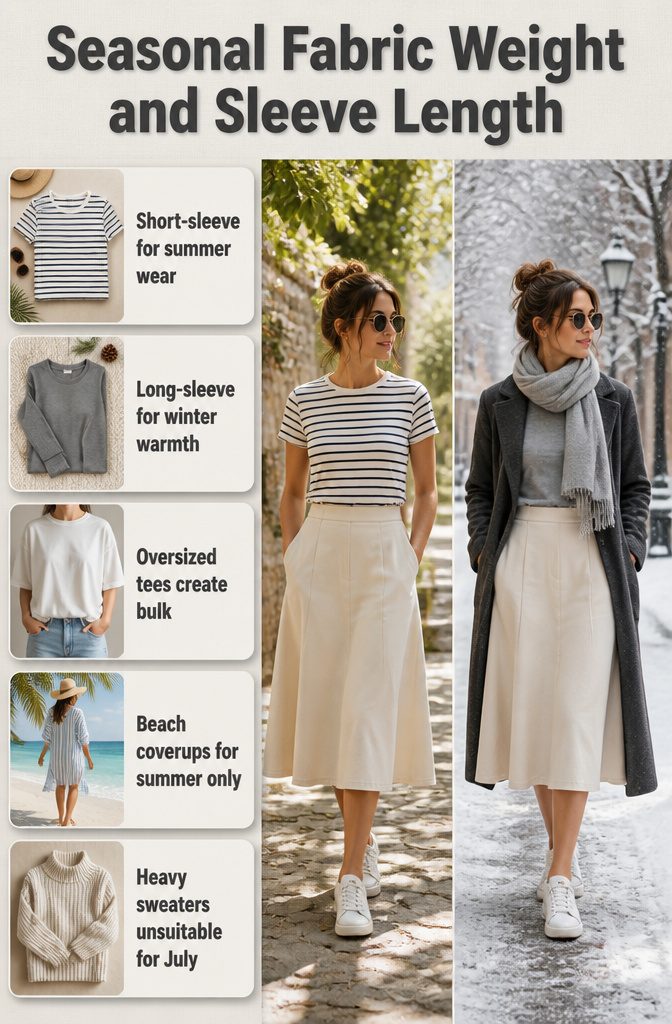
A short-sleeve linen stripe in July and a long-sleeve cotton jersey in January share the same formula: tucked into a midi skirt with sneakers.
The skirt and shoes stay; the tee changes weight. That swap carries most of the list year-round.
The summer version needs the more fitted cut.
An oversized linen tee bunches at the waistband and rides up by noon. The winter version, a basic long-sleeve crew or v-neck, layers cleanly under a sweater or jacket with sleeves long enough to peek out.
Some formulas retire seasonally. The beach coverup use, the bare-arm look with a sleeveless dress layered over, and the denim shorts pairing all depend on exposed skin or airflow that January does not provide.
A turtleneck stripe can sub into the skirt-and-sneakers formula, but it reads as a different piece, not a swap.
The thicker boatneck or sweater-weight stripe sits in its own category. It dresses up enough for occasions where a standard tee falls flat, yet it is too heavy for July and too structured for true layering.
I keep one, wear it October through April, and do not pretend it covers the same ground as the jersey basics.
Accessorizing Rules That Actually Hold
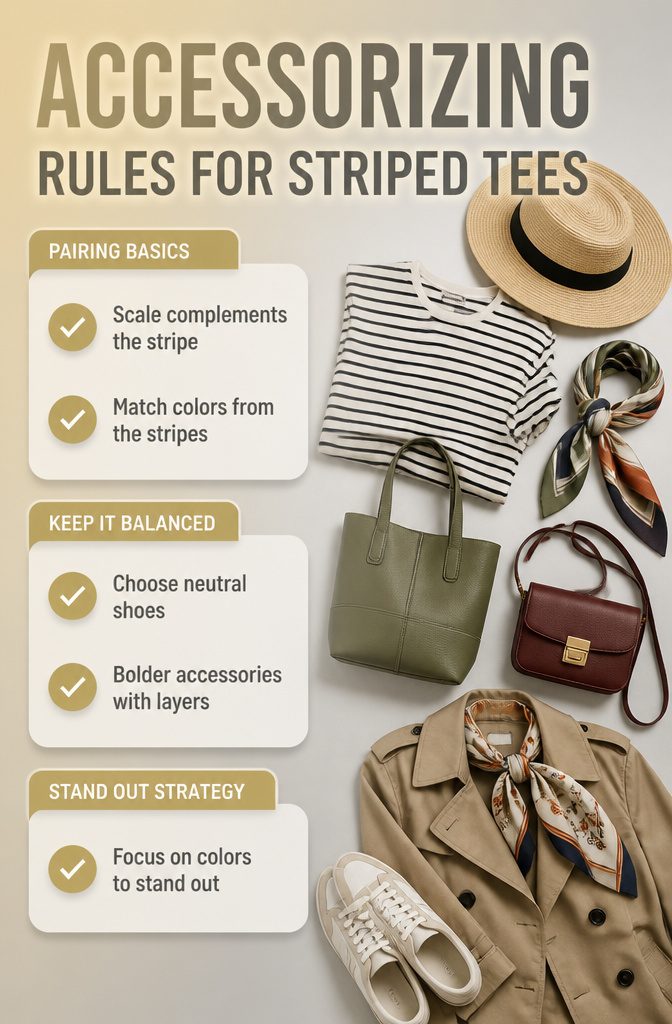
Scarves, hats, and bags with a striped tee follow two rules that actually show up in results. Here is how they work.
- Scale is what keeps the stripe from fighting the accessory. A wide-brim hat or oversized tote needs breathing room, so pair it with a tee that has wider stripes or more space between them. A narrow stripe can handle a slim silk scarf or a small crossbody without looking busy.
- Pull color from the stripe itself, not from somewhere else in the closet. A multi-stripe tee already carries its own palette, which makes matching easier than starting from a solid top. Pick the least expected color in the stripe for your bag or scarf, and the outfit reads intentional rather than safe.
- Neutral sneakers keep the focus on the stripe when you are already working with olive or another non-obvious bottom color. The same logic applies to accessories: let the stripe and the pulled color do the work, and keep the third piece quiet.
- A trench coat over the tee changes the math. The coat becomes the dominant shape, so the accessory can be slightly bolder without tipping into too much. This is where a brighter bag or a patterned scarf actually stabilizes the look instead of cluttering it.
Mixing Stripes With Other Patterns
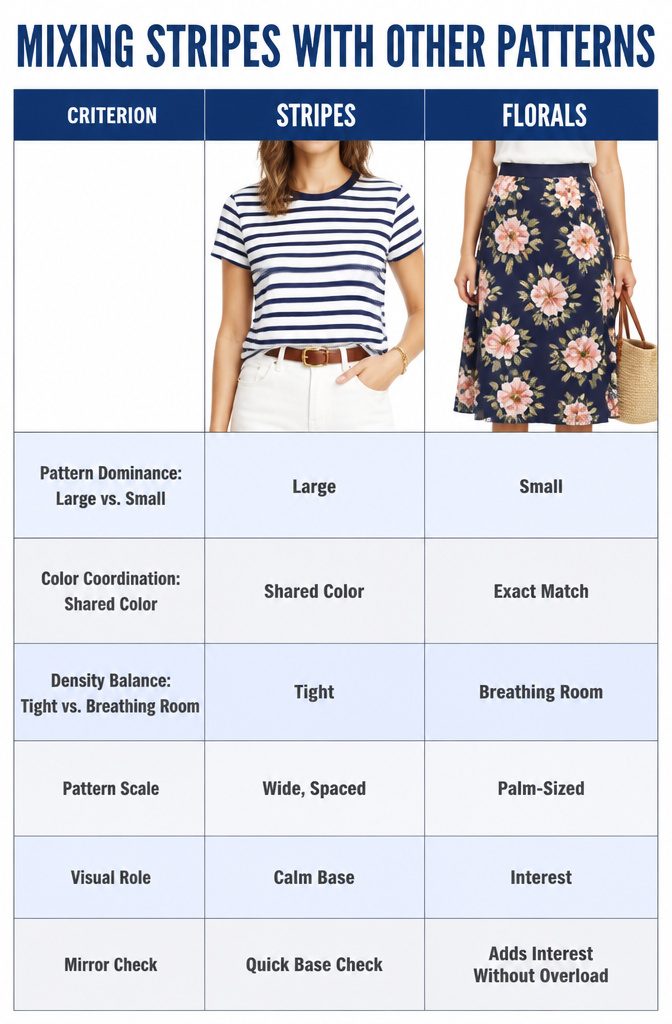
A striped t-shirt with florals only works when one pattern clearly dominates.
I learned this after three failed mornings of trying a narrow stripe against a small floral; both patterns fought for attention and the mirror showed noise, not an outfit.
The fix is one large-scale piece and one small-scale piece, always. A wide, spaced stripe on the tee reads as the calm base, while a floral skirt with palm-sized blooms becomes the interest.
Reverse it and the effect holds: a micro-stripe tee under a bold plaid blazer where the checks are the size of a hand.
Color anchors the whole thing. Both patterns need to share at least one exact shade, not just a color family.
Navy stripes with a floral that picks up the same navy keeps the eye from bouncing. Without that shared thread, you are wearing two outfits at once.
Density matters too.
A dense stripe, tight and frequent, needs a print with breathing room between its motifs. Two dense patterns stacked together flatten the body and add visual weight where most of us do not want it.
The stripe density you choose should sit opposite the print density, and checking that balance takes about ten seconds in the mirror before you walk out.
What Makes Stripes Read Dated
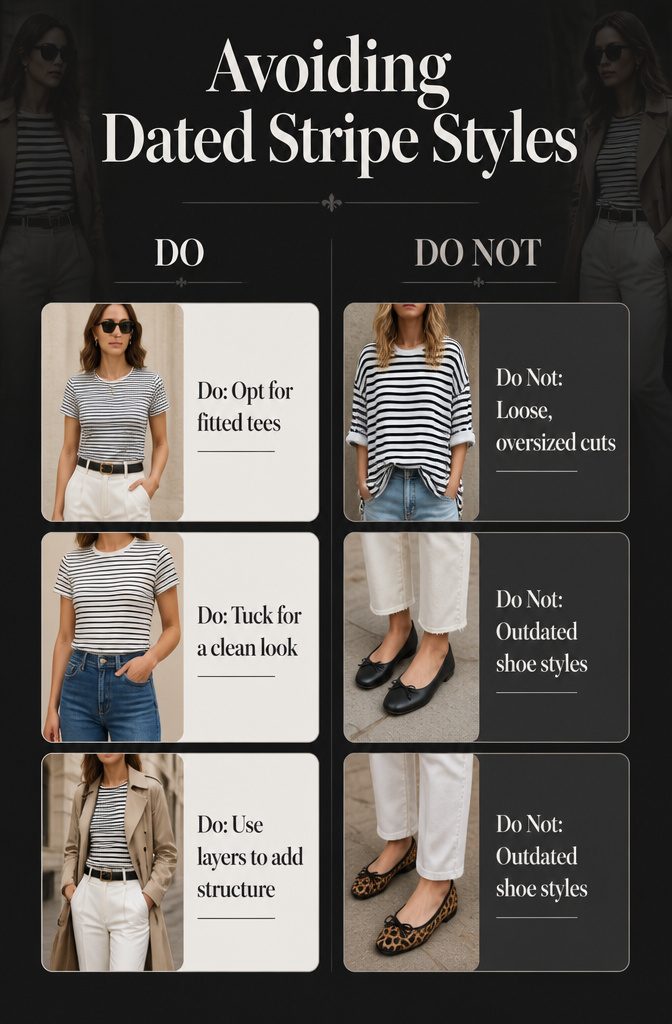
The oversized striped tee knotted at the waist still turns up in spring outfit roundups, but the proportion has shifted.
What read as relaxed five years ago now scans as frumpy unless the shoulder seam actually hits the shoulder and the knot is doing structural work, not just hiding excess fabric.
A half-tuck into mid-rise straight-leg jeans keeps the same casual intent with a cleaner line.
French styling tends to run the tee in a true slim or straight cut, tucked fully into wide-leg trousers with ballet flats.
The stripe width matters here: the H&M tee at $13 and similar entry-price points usually carry a medium stripe that competes with the pant volume.
A finer gauge stripe, or a single bold stripe rather than repeated narrow ones, lets the silhouette read intentional.
White jeans with a black-and-white striped tee and leopard flats remains a working combination, but the shoe has to be current in proportion.
A pointed flat or a slim sandal keeps it in 2024; a rounded ballet toe or heavy hardware drags it toward costume.
The same tee with a trench and white trousers for the office works because the coat adds the structure the tee lacks on its own.
The fit of the tee itself is the variable that dates the look, not the pairing.
A shoulder that slips past the joint, a hem that covers the hip without a deliberate tuck, a neckline that has relaxed into a boatneck without meaning to: these are the details that signal "classic" versus "stuck."
Frequently Asked Questions
What can I wear with a striped t-shirt?
A striped t-shirt works with wide-leg trousers and ballet flats, straight-leg jeans and sandals, skinny jeans under a trench coat with pointy-toed heels, white jeans with leopard flats or nude heels, leggings and a cardigan, denim shorts with Converse sneakers, a midi skirt, joggers with leather sneakers or loafers, or a leather skirt.
Match the tee’s fit and stripe width to the bottom half so neither piece competes for attention.
How do you style a striped shirt?
Style it by controlling proportions and texture: half-tuck into mid-rise or high-rise bottoms to anchor the waist, choose narrow stripes against voluminous pieces and wider stripes against simpler cuts, and let one element lead.
For layering under sweaters or sleeveless dresses, check that necklines meet cleanly and stripes stay visible through the top fabric. A single accessory like a watch or small hoop finishes without overworking the look.
Can you wear stripes with other patterns?
Stripes pair best with solids rather than competing patterns. If you want texture, use it in accessories or footwear rather than in a second print.
Are stripes out of fashion in 2026?
Striped tees keep getting called a "timeless classic" and "versatile piece that deserves a spot in every wardrobe."
What is the rule for striped shirts?
The core rules are: match stripe width to the bottom half’s volume, narrow stripes read as texture and let voluminous pieces lead while wide stripes need simpler cuts; tuck deliberately with a half-tuck or French tuck to define waist; and keep one statement per outfit, whether that is the stripe itself, an asymmetric hem detail, or a bold shoe, never multiple competing focal points.